
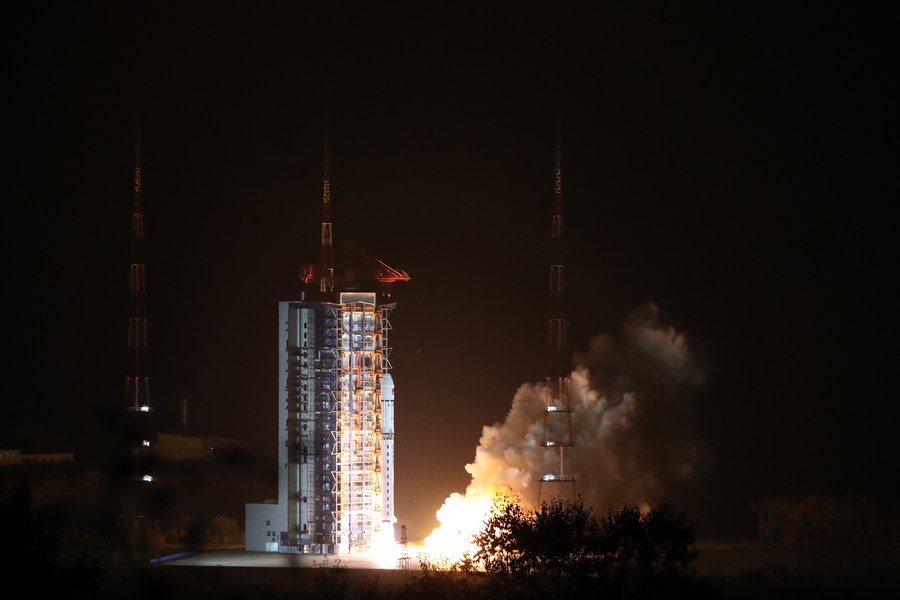
A Long March-2D rocket carrying China's first solar exploration satellite blasts off from the Taiyuan Satellite Launch Center in north China's Shanxi Province, Oct. 14, 2021.(Photo by Zheng Bin/Xinhua)
BEIJING, Aug. 30 (Xinhua) -- China's first solar exploration satellite has observed nearly 100 solar eruptions and completed its in-orbit tests and experiments, said the China National Space Administration (CNSA) at a press conference Tuesday.
The scientific data from the satellite's observations has been officially released and shared with the world, said Zhao Jian, chief designer of the country's Gaofen project, at the press conference on the satellite's progress.
Launched in October last year, the satellite, Xihe, operates in a sun-synchronous orbit at an average altitude of 517 km, with a solar Hα imaging spectrometer as its main scientific payload.
The satellite has, for the first time globally, obtained the fine structure of solar Hɑ, SiΙ and FeΙ spectral lines in orbit, which can directly reflect the characteristics of solar eruptions, Zhao said.
In cooperation with the China Aerospace Science and Technology Corporation, Nanjing University and the Chinese Academy of Sciences, the CNSA has conducted the in-orbit performance verification and engineering application of the satellite platform technology with ultra-high precision and stability.
Unlike the traditional design, the new satellite platform has adopted maglev control technology to ensure that the load imaging is not affected by the vibrations of the platform and to obtain more stable and accurate imaging, Zhao said.
The technology is expected to be used in the country's future space missions, including high-resolution remote sensing, solar stereoscopic detection and extrasolar planet discovery, Zhao added.
以“聚媒智 启新程——携手构建中阿命运共同体”为主题的“全球南方”媒体智库高端论坛中阿伙伴大会12日在位于埃及首都开罗的阿拉伯国家联盟(阿盟)总部开幕,来自中国和阿拉伯国家约110家媒体、智库、政府机构、企业及国际和地...
 English
 注册
注册


 首页
首页
 动态信息
动态信息
 交流活动
交流活动
 研究成果
研究成果
 成员信息
成员信息
 联系我们
联系我们